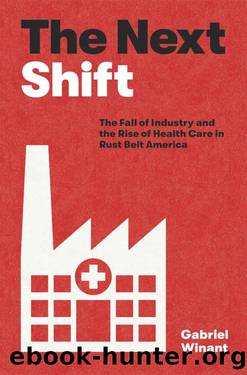
The Next Shift by Gabriel Winant
Author:Gabriel Winant [Winant, Gabriel]
Language: eng
Format: epub
ISBN: 9780674259836
Publisher: Harvard University Press
Published: 2021-03-23T04:00:00+00:00
The Bottom Falls Out, 1978â1985
At the end of the 1970s, steelâs long, slow decline accelerated. Steel mills were operating at 78 percent capacity in 1977, the year of Sadlowskiâs defeat; imports had risen to 20 percent of the domestic market. On âBlack Monday,â September 19, 1977, Youngstown Sheet and Tube closed and laid off five thousand workersâthe first major plant closure in basic steel. When Paul Volckerâs Federal Reserve began deflating the economy in 1979, credit-sensitive sectors like real estate and the automotive industry absorbed the immediate shock, which they passed up the supply chain to steel. That year, LTV Steel, which had acquired Jones & Laughlin Steel, shut down the Eliza Furnacesâhuge blast furnaces in the heart of Pittsburgh. By 1980, American steel was running at only 50 percent capacity.18
The severe downturn that closed out the 1970s ended the cycle known as âstagflation.â Manufacturers feeling the sting of declining profitability, driven by the resurgence of global competition in manufacturing and inflating input costs, had delayed a major conflict with labor by assenting to wage increases and passing along the cost to customers as price hikes. Although the two phenomena had been believed to work at odds, a simultaneous increase of unemployment and inflationâstagflationâensued. This dynamic was the target of new Federal Reserve chairman Paul Volcker when he observed that, for some number of Americans, living standards would have to fall. Steelworkers were just the kind of Americans he had in mind.19
At the level of macroeconomic governance, the phenomenon often called neoliberalism arose in immediate response to the structural crisis of stagflation. Its most dramatic manifestation came in the action of the Federal Reserve in 1979 to contract the money supplyâthe so-called âVolcker shock.â Because the old industrial centers lay at the heart of the stagflationary dynamicâkept afloat amid sinking profitability by inflationâthey were dealt the harshest blow by the Fedâs action. The ensuing recession was most acute for blue-collar workers. In the Pittsburgh area, most of the big mills entered the final phases of their shutdown cycles, zeroing out employment within a few years. A member of the Federal Reserve Open Markets Committee warned Volcker in June 1980, âThe steel industry is very much in a state of panic.â20 In Pittsburgh, the downturn was ruinous.
It was thus at the end of the 1970s that the working-class communities of southwestern Pennsylvania tipped from cyclical, gradually worsening distress into general social crisis. Investigating the situation in the steelmaking areas, a group of scholars noted that unemployment had run between 16 and 25 percent above the Allegheny County average before the 1979â1980 recession. Once the downturn began in the middle of 1979, the regional labor market lost more than half of the jobs in the steel industry, with unemployment rates rising in some mill towns almost half again higher than in the county at large. âUntil 1980 the decline of the milltowns had been a gradual process marked by a steady out-migration of steelworkers to worker suburbs and by shrinking employment in the mills,â wrote the authors.
Download
This site does not store any files on its server. We only index and link to content provided by other sites. Please contact the content providers to delete copyright contents if any and email us, we'll remove relevant links or contents immediately.
| Anthropology | Archaeology |
| Philosophy | Politics & Government |
| Social Sciences | Sociology |
| Women's Studies |
Born to Run: by Christopher McDougall(7127)
The Leavers by Lisa Ko(6948)
iGen by Jean M. Twenge(5416)
Sapiens by Yuval Noah Harari(5370)
Spare by Prince Harry The Duke of Sussex(5197)
The Kite Runner by Khaled Hosseini(5179)
Machine Learning at Scale with H2O by Gregory Keys | David Whiting(4313)
Bullshit Jobs by David Graeber(4190)
Never by Ken Follett(3957)
Goodbye Paradise(3810)
Livewired by David Eagleman(3774)
Fairy Tale by Stephen King(3399)
A Dictionary of Sociology by Unknown(3085)
Harry Potter 4 - Harry Potter and The Goblet of Fire by J.K.Rowling(3074)
The Social Psychology of Inequality by Unknown(3031)
The Club by A.L. Brooks(2925)
Will by Will Smith(2920)
0041152001443424520 .pdf by Unknown(2846)
People of the Earth: An Introduction to World Prehistory by Dr. Brian Fagan & Nadia Durrani(2736)
